 Montevideo City Guide
Candombe: Where to Hear Uruguay's Drums in Montevideo
Candombe, on UNESCO's heritage list since 2009, is the Afro-Uruguayan drum and dance practice of Barrio Sur, Palermo and Cordón, played in the streets of Montevideo since the colonial era. This page gives you where and when to hear the candombe drums for free, the four dates in the year you can plan around, the three drums and the characters who dance in front of them, the history from the slave port to Barrio Sur, and the show you can book on any night. It is one of the most distinctive things to do in Montevideo.
Quick answer What it is, where to hear it, when
Candombe is played on three drums, the piano, the repique and the chico, and the Desfile de Llamadas puts more than 2,500 drums along ten blocks of Isla de Flores. Outside carnival, the drums go out on Sundays and many holidays in Barrio Sur and Palermo, and you hear them free from the pavement. The decision is simple: a weekday visitor books a dinner show, a Sunday visitor walks from the old city into Barrio Sur and follows the sound.
Key takeaways
- In town Monday to Saturday? Book the candombe and tango dinner show, $107 per person with a three-course dinner and about three hours of stage time.
- Want to play rather than watch? The private old-town walk with a candombe drum class option runs 2.5 hours at $129 per group and suits kids and all levels.
- In town in early February, the Desfile de Llamadas is the biggest night of Uruguay's carnival, with more than 2,500 drums on Isla de Flores.
- Any day of the year, the Museo del Carnaval explains the drums, the costumes and the comparsas.
Key facts
Opening hours
| Street llamadas | Sundays and many holidays–No published start time |
|---|---|
| Desfile de Llamadas | Two nights in early February–Dates set by the city each year |
Closed No fixed weekday drumming, Monday to Saturday book the show or the class
Admission
- Adult
- Free in the street
- Reduced
- Desfile de Llamadas boxes are paid, the pavement is free
- Free
- Every Sunday llamada and the 6 January San Baltasar parade
Planning it
- Time needed
- Our estimate: an hour to follow a Sunday llamada, a full evening for a Llamadas night or the dinner show
- Address
- Barrio Sur and Palermo, Isla de Flores (Carlos Gardel) and Peatonal Curuguaty, Montevideo
Street candombe costs nothing. The rows below compare the two bookable ways to hear or play the drums, with prices as the operators list them, against the free street llamada.
Are you in Montevideo on a Sunday or in early February, or on a weekday night?
| Option | Price | Book |
|---|---|---|
| Candombe, tango and folklore dinner show at El MilongónWeekday visitors who want the drums on stage with a three-course dinner, about three hours from 8.30 pm | $107 per person | Check Availability |
| Private old-town walk with a candombe drum class optionFamilies and groups who want to play a rhythm, 2.5 hours from the Mercado del Puerto | $129 per group | Check Availability |
| Desfile de Llamadas, tourist boxesVisitors in early February who want a seat, hosts and toilets on the parade route | Paid boxes, standing on the pavement is free | Official site |
Sunday llamadas in Barrio Sur and Palermo are free and need no booking. Figures current {checked}.
Book the Drums Ahead
Two outings put candombe on a fixed time and place, useful on the six days a week when the streets promise nothing.
 from $107
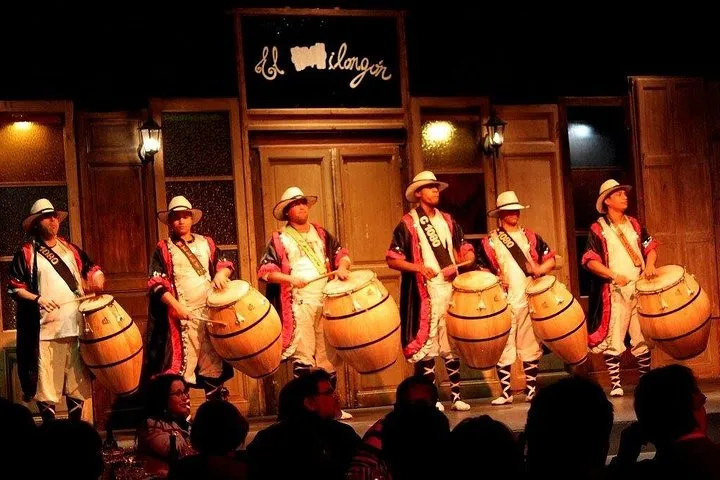
El Milongon Dinner & Show: Candombe, Tango and Folklore
An evening dinner show combining candombe, tango and folklore with a three-course meal and optional hotel transfers.
Check Availability from $129
Private Walking Tour in Montevideo
A private certified-guide walking tour of the old city that starts within walking distance of the cruise port, with an optional candombe drum class.
Check AvailabilityPrices, ratings and details are the platform's own. Dollar figures are the listed prices. The platform bills in your account's currency.
What Candombe Is
Candombe is a street practice, not a stage show. That shapes everything about how you experience it.
A Drum Call, Not a Concert
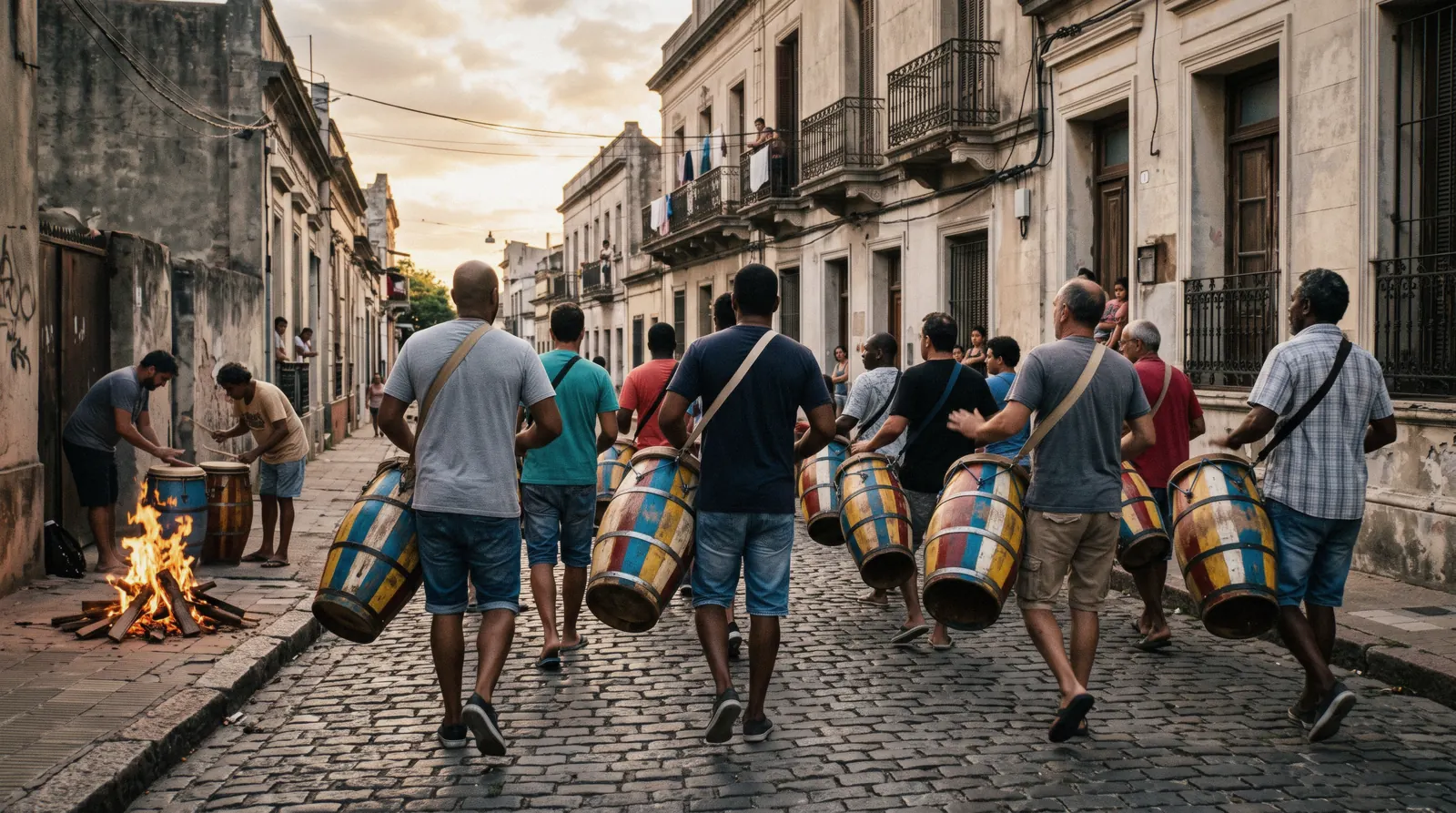
UNESCO inscribed candombe on its list of intangible cultural heritage in 2009, describing a community practice: every Sunday and on many holidays the drum calls go out in the Sur, Palermo and Cordón barrios. Drummers tune their skins around communal fires, the most respected families lead the line and others follow in rows, and neighbours watch from balconies. The beat of the piano drum, the largest of the three, differs from barrio to barrio, which is how locals hear where a cuerda comes from.
The practical consequence is that nobody sells a ticket for a Sunday llamada. You stand on the pavement, wait for the fires and let the line of drummers pass within arm's reach.
The Word and Its Roots
Around 1800, the gatherings of enslaved Africans and their descendants in the Río de la Plata were called tangos or tambos. The word candombe appears from 1830 in Montevideo's record, and language sources trace it to Kikongo, a language of Central Africa, with its first recorded use in Buenos Aires. Keep one distinction straight: candombe is the Afro-Uruguayan drum and dance practice of Montevideo, while Candomblé is a Brazilian religion.
They share African roots and nothing else, and locals will notice if you mix them up. Within candombe itself there are three mother rhythms named after the old tenement streets that produced them.
Source: UNESCO, Descubrí Montevideo, Wikipedia.
Where and When to Hear Candombe in Montevideo
The rule of thumb is Sundays and holidays, in Barrio Sur and Palermo, the two barrios east of the old city. Start from there and everything else is detail.
Barrio Sur and the Old Cuareim Street
Barrio Sur was one of the first barrios built outside the colonial walls, and after the abolition of slavery in 1842 Afro-Uruguayans settled there in big tenement houses called conventillos. The most famous was the Mediomundo at Cuareim 1080, opened in 1885 with 40 rooms around a central patio. It gave its name to the Cuareim rhythm, one of the three mother beats, and the comparsa C1080 still carries the street number today.
Mind the street-name trap: Cuareim is now signposted Zelmar Michelini, and Isla de Flores is signposted Carlos Gardel, so an old map sends you looking for names that are no longer on the signs. Barrio Sur sits just east of Ciudad Vieja.
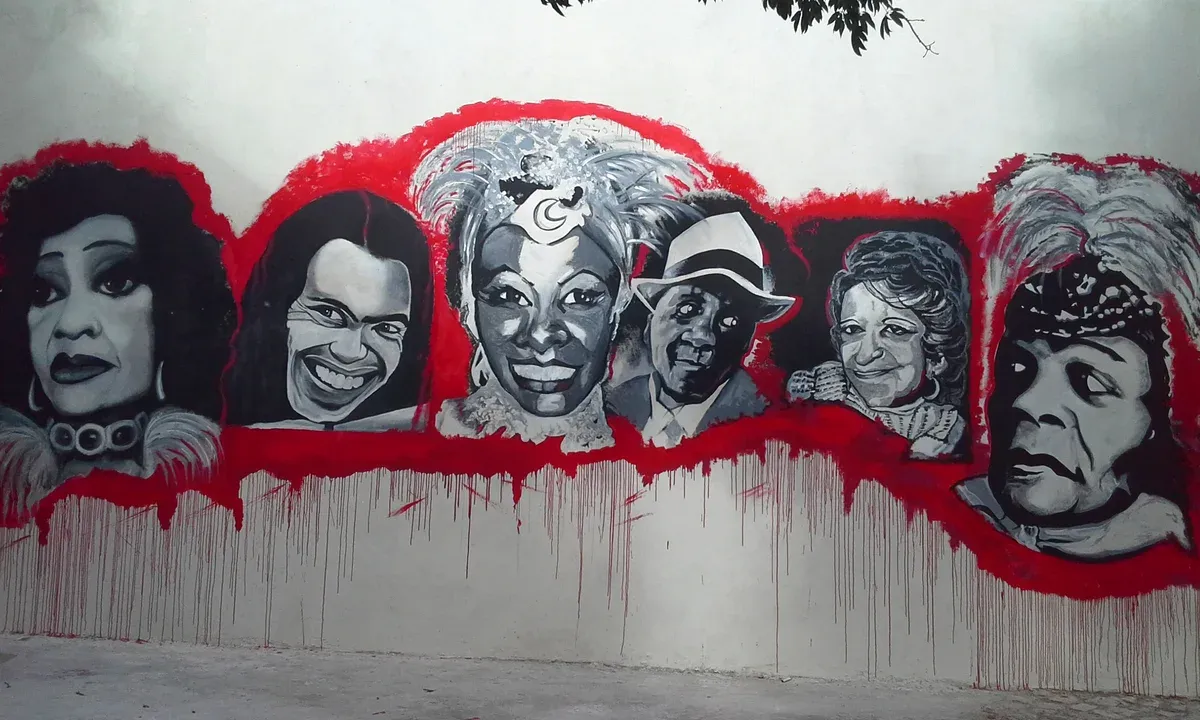
A mural of candombe and carnival figures on the Peatonal Curuguaty, the Peatonal del Candombe. Photo: Señoritaleona, CC BY-SA 4.0, via Wikimedia Commons
Palermo and the Ansina Beat
Palermo, the next barrio east, took its name from a grocery sign in the 1860s belonging to a Sicilian family. Its own tenement row, the Reus al Sur housing of the 1880s, produced the second mother rhythm, the Ansina beat, still tied to this barrio. The street to walk is Peatonal Curuguaty, called the Peatonal del Candombe, which runs from Plaza Carlos Gardel down to the corner of Héctor Gutiérrez Ruiz and José María Roo.
Candombe murals line it, so it works on a quiet weekday too, when no drums are out. Palermo and Barrio Sur run into each other without a clear border, so you can cover both in one walk.
The Latido Afro Circuit
Latido Afro is a self-guided cultural circuit through Barrio Sur and Palermo with twelve geolocated points. Each is marked with a plaque or a totem, and the app plays videos narrated by Afro-descendant residents of the barrio, so the street tells you its own story. There is a murals map in the app too.
It is free to follow, and it is the best thing to do on a weekday, when no street drums are promised. Pair it with a walk along the Rambla, which runs east from the old city along the water in front of both barrios.
On a Weekday: the Show or the Class
From Monday to Saturday no street drumming is promised, so a weekday visitor has two bookable options. The first is the candombe and tango dinner show at El Milongón on Gaboto 1810, about three hours of candombe, tango and folklore with a three-course dinner, $107 per person, arriving 8.30 pm if you skip the hotel transfer. The second is the private old-town walking tour with a candombe drum class variant, $129 per group for 2.5 hours, open to all levels and to kids, starting at Yacaré and Piedras by the Mercado del Puerto.
Both sit with the rest of the city's bookable outings on Montevideo tours.
Source: Descubrí Montevideo, Latido Afro, Wikipedia.
The Three Candombe Drums and the Comparsa
The sound you hear is three barrel drums in conversation, with dancers in front.
Chico, Repique and Piano
The chico is the smallest drum and the highest pitched, and it sets the pulse that everything else hangs on. The repique is the middle drum, and the player improvises against the pulse. The piano is the largest and it carries the bass role.
That piano line is the beat that names the barrio, since it differs from Sur to Palermo to Cordón. A cuerda, the drum line, needs at least three drummers to function, and a full one puts 50 to 100 players in rows. Each drum hangs from a shoulder strap called a talí and is played with one stick and one open hand at the same time.
| Drum | Size and role in the cuerda |
|---|---|
| Chico | Smallest, highest pitch, sets the pulse |
| Repique | Medium, improvises against the pulse |
| Piano | Largest, carries the bass, the beat that names the barrio |
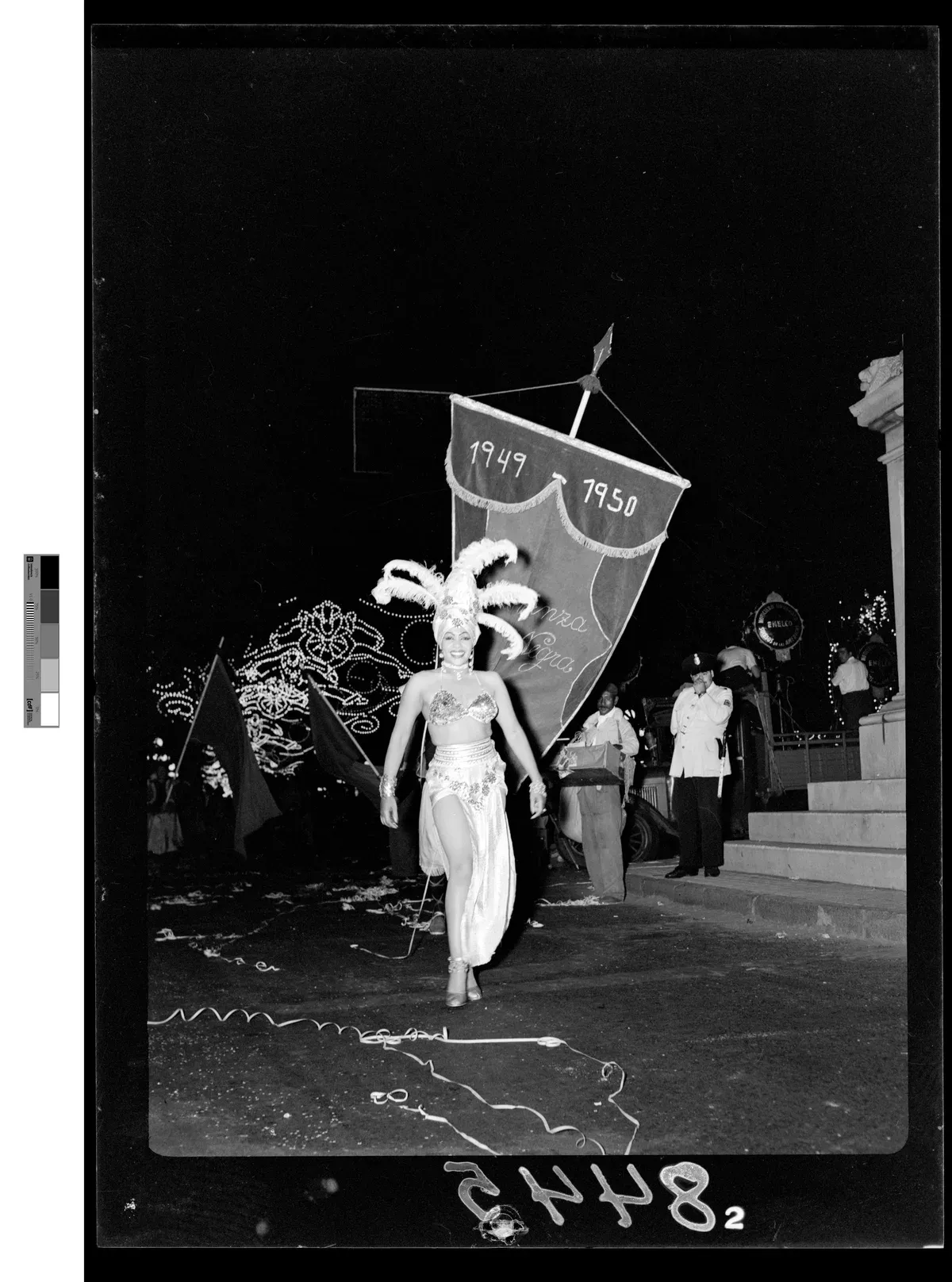
Martha Gularte, a pioneer of the vedette role, parading with the comparsa Añoranzas Negras in 1950. Photo: DEMARTINO TRONCONE Carmelo, CC0, via Wikimedia Commons
Mama Vieja, Gramillero and Escobero
A full comparsa opens with a banner, moons, stars and giant flags carried high, then come the dancers and the old characters everyone waits for. The Gramillero is the healer, dressed in a frock coat and top hat and carrying a bag of herbs. The Mama Vieja dances slowly with him, waving a fan and holding a parasol.
The Escobero spins a broom, a role that once guided the drummers. Vedettes dance in front of the cuerda, a role that grew through the 20th century with pioneers such as Martha Gularte. In practice, these characters appear in full dress at the Desfile de Llamadas and on carnival stages, not at a small Sunday llamada, where the drums themselves are the point.
How to Dance Candombe
The dance follows the cuerda. You take short, measured steps in time with the piano, and Descubrí Montevideo notes that the short, measured step of the drummers recalls enslaved people in chains and ankle irons. There is no fixed routine to memorise in the way tango has one.
The practical way in is to watch the vedettes for a few minutes, then step in behind the line if the mood allows. To actually learn the beat, a drum class is the honest answer, and the private old-town walk with a candombe drum class option is open to beginners and children. The price is per group, so a family pays one rate.
Source: Uruguay Natural, Wikipedia, Descubrí Montevideo.
From the Slave Port to the Streets of Barrio Sur
The drums carry two and a half centuries of Montevideo history, and two of its dates still set the calendar.
The Port and the Salas de Nación
In the second half of the 18th century, the Port of Montevideo was the only legal entry point for enslaved Africans into the Viceroyalty of the Río de la Plata. By the end of that century, 35 percent of Montevideo's population was of African descent. In the free hours they were allowed, people recreated the rites of their nations of origin in the associations known as Salas de Nación.
The Ministry of Education and Culture traces the drum calls to at least 1760, when groups organised by African nation met on small plots of earth beside the city wall, and counts more than twenty African peoples in the mix that became candombe. Slavery was abolished in Uruguay in 1842, and afterwards Afro-Uruguayans settled in the conventillos of Barrio Sur and Palermo, the big tenement houses where candombe as you hear it today took shape.
Mediomundo and 3 December
The Conventillo Mediomundo at Cuareim 1080 opened in 1885 with 40 rooms around a patio, and its courtyard llamadas shaped the Cuareim rhythm. On 3 December 1978, under the dictatorship, the city evicted its residents, and they answered by playing the last llamada in the building that day. It was demolished two days later.
The date did not disappear. Ley 18.059 of 2006 made 3 December the national day of candombe, Afro-Uruguayan culture and racial equity, and on 3 December 2019 a plaque went up on the apartment building that now stands on the site. The comparsa C1080 keeps the address in its name.
Source: Descubrí Montevideo, Ministry of Education and Culture, IMPO, Wikipedia.
Four Free Dates in the Afro-Uruguayan Year
If you can time a trip, these four dates put Afro-Uruguayan culture in the street for free. Three of them are drum nights, the fourth is a beach ritual from the same communities.
Each of the four dates below is free to watch from the pavement or the sand, with the place and the cost of a better view.
| Date | What happens | Where | Cost |
|---|---|---|---|
| 6 January | Llamadas de San Baltasar, dozens of comparsas | Isla de Flores (Carlos Gardel), afternoon | Free |
| 2 February | Iemanjá offerings at sunset | Playa Ramírez, also Buceo and Cerro | Free |
| Early February, two nights | Desfile de Llamadas, more than 2,500 drums | Isla de Flores, Héctor Gutiérrez Ruiz to Minas | Free from the pavement, paid boxes |
| 3 December | National candombe day | Barrio Sur, programme on the ministry agenda | Free |
6 January: Llamadas de San Baltasar
The Llamadas de San Baltasar run on the afternoon of 6 January along Isla de Flores street, free to watch, with dozens of comparsas. They honour San Baltasar, the saint of the Magi king Balthazar, and they are the oldest drum date in the calendar. Descubrí Montevideo calls this the first drum festivity in carnival history, going back to around 1830, long before the modern parade existed.
Come in summer, bring water, and remember the street signs now say Carlos Gardel.
2 February: Iemanjá on the Beach
Every 2 February, the Afro-Umbanda celebration of Iemanjá, the goddess of the sea, fills Montevideo's beaches at sunset as the faithful arrive in white and light blue with their offerings. Playa Ramírez draws the most people, and there are gatherings in Buceo and at the Cerro too. It is a religious offering rather than a llamada, so watch from a respectful distance.
It is free and crowded, so arrive early for a spot near the water. It pairs well with a summer evening on Montevideo's beaches.
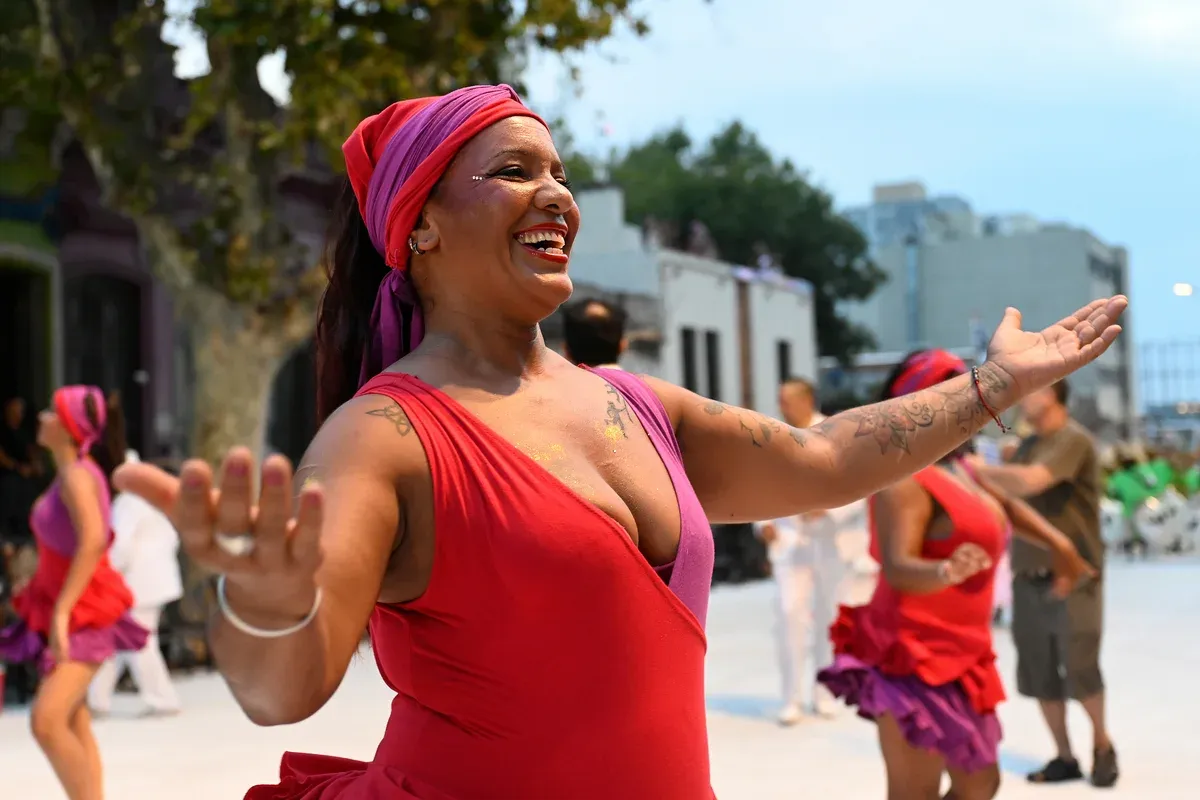
A comparsa dancer on the first night of the Desfile de Llamadas in 2024. Photo: Sala de Medios - Intendencia de Montevideo, CC BY-SA 4.0, via Wikimedia Commons
Early February: the Desfile de Llamadas
The Desfile de Llamadas is the biggest drum event of the year: two nights in early February, more than 2,500 drums and more than 6,000 people parading along ten blocks of Isla de Flores between Héctor Gutiérrez Ruiz and Minas. The first official parade was held in 1956. Standing on the pavement is free.
The paid option is a tourist box, or palco, with hosts, toilets and security. The city sets the exact two nights each year, so check the Montevideo Intendencia calendar before you book flights. The parade is the loud heart of carnival in Uruguay, which runs about forty days from late January.
3 December: National Candombe Day
Ley 18.059 set 3 December as the Día nacional del candombe, la cultura afrouruguaya y la equidad racial, in memory of the Mediomundo eviction of 1978. The Ministry of Education and Culture publishes the activities for each year on its agenda, so check it the week before. The date never moves, and the plaque on the new building at the old Cuareim 1080 site is worth finding on the day.
Combine it with the Latido Afro circuit for the full story.
Source: Llamadas de San Baltasar, Iemanjá, Desfile de Llamadas, IMPO.
Candombe in Nine Dates
-
Late 18th century
The slave port
The Port of Montevideo is the only entry for enslaved Africans into the Viceroyalty of the Río de la Plata, and by century's end 35 percent of the city is of African descent.
-
Around 1800
Tangos and tambos
The gatherings of enslaved Africans and their descendants are called tangos or tambos, with drumming at the centre.
-
1830
The word candombe
The word candombe appears in the record, and the Llamadas de San Baltasar become the first drum festivity in carnival history around this time.
-
1842
Abolition
Slavery is abolished in Uruguay, and Afro-Uruguayans settle in the conventillos of Barrio Sur and Palermo.
-
1885
Mediomundo opens
The Conventillo Mediomundo opens at Cuareim 1080 with 40 rooms around a patio, home of the Cuareim rhythm.
-
1956
First official Llamadas
The first official Desfile de Llamadas parade is held on Isla de Flores.
-
3 December 1978
The last llamada
The dictatorship evicts the Mediomundo residents, who play the last llamada that day. The building is demolished two days later.
-
2006
National day
Ley 18.059 makes 3 December the national day of candombe, Afro-Uruguayan culture and racial equity.
-
2009
UNESCO listing
UNESCO inscribes candombe and its socio-cultural space on the Representative List of the Intangible Cultural Heritage of Humanity.
Dates below come from Descubrí Montevideo, UNESCO, IMPO, the Uruguayan law database, and Wikipedia.
Do and Don't at a Llamada
Do
- Stand on the pavement and let the cuerda come to you
- Arrive early on Llamadas nights, since ten blocks fill up fast
- Follow the drummers' pace with your feet if you join the crowd behind
- Look for the fires where drummers tune their drums, they mark where a Sunday line will form
- Check the city's carnival calendar before you plan a February trip
Don't
- Don't walk through the middle of the cuerda
- Don't stand in the street ahead of an approaching drum line
- Don't expect a start time, the drums go out when they go out
- Don't confuse candombe with Candomblé, the Brazilian religion
- Don't follow an old map's street names, Cuareim and Isla de Flores have been renamed on the signs
Five Things Most Visitors Do Not Know
- The piano drum beat is different in every barrio, so a local can hear whether a cuerda comes from Sur, Palermo or Cordón before they see it. (UNESCO) - A full cuerda is 50 to 100 drummers in rows, and each drum hangs from a strap called a talí, played with one stick and one hand at once. (Wikipedia) - The comparsa C1080 is named after a street number, the Mediomundo tenement at Cuareim 1080.
(Wikipedia) - The street names changed: Cuareim, the Mediomundo street, is now signposted Zelmar Michelini, and the Llamadas street Isla de Flores is signposted Carlos Gardel. (Wikipedia) - The Palermo barrio is named after a Sicilian family's grocery sign from the 1860s, and its Reus al Sur housing gave the Ansina rhythm its name. (Descubrí Montevideo)
Candombe on the Map
The drum barrios sit east of Ciudad Vieja along the Rambla Sur. The pins show where the history happened and where to hear it now.
Coordinates approximate, from OpenStreetMap.
Next Stops From the Drum Barrios
Three places pair naturally with a candombe afternoon.
Carnival in Uruguay
The forty-day season that the Llamadas crown, with murgas on neighbourhood stages and the contest at Teatro de Verano.
Museo del Carnaval
Drums, costumes and comparsa history by the port, the year-round way to see what the Llamadas look like.
Ciudad Vieja
The old port town just west of Barrio Sur, where most visitors start the day and where the drum class walk begins.
Candombe Questions
What is candombe?
Candombe is the Afro-Uruguayan drum and dance practice of Montevideo, played on three barrel drums in the barrios of Barrio Sur, Palermo and Cordón. UNESCO inscribed it on its intangible cultural heritage list in 2009, describing a community practice in which drum calls go out every Sunday and on many holidays, with drummers tuning around communal fires and neighbours watching from balconies.
What does the word candombe mean?
Around 1800 the gatherings of enslaved Africans were called tangos or tambos, and the word candombe dates from 1830 in Montevideo's record. Language sources trace it to Kikongo, with its first recorded use in Buenos Aires. In practice it names both the drum music and the whole event, drums, dancers and characters together.
Is candombe the same as Candomblé?
No. Candombe is the Afro-Uruguayan drum and dance practice of Montevideo. Candomblé is a Brazilian religion. They share African roots and nothing else,.
Where can I hear candombe in Montevideo?
Barrio Sur and Palermo, the two barrios east of the old city, are the home ground. Walk from Ciudad Vieja towards the water and follow the sound. On a weekday, the candombe and tango dinner show brings the drums to a stage at El Milongón with dinner included.
Which day do the candombe drums play?
Sundays and many holidays are the rule in Barrio Sur and Palermo, with no published start time. Drummers tune around communal fires first, so follow the fires. If your trip runs Monday to Saturday, book the dinner show or the drum class on the private old-town walk.
When is the Desfile de Llamadas?
Two nights in early February, along ten blocks of Isla de Flores between Héctor Gutiérrez Ruiz and Minas. More than 2,500 drums and more than 6,000 people take part. The exact nights are set by the city each year, so check the Montevideo Intendencia calendar before booking flights. See carnival in Uruguay for the wider season.
What are the three candombe drums?
The chico, the repique and the piano. The chico is the smallest, highest pitched and sets the pulse. The repique is medium sized and improvises. The piano is the largest and carries the bass, and its beat differs by barrio. A cuerda needs at least three drummers, and a full one has 50 to 100 players.
Can visitors join or learn to drum?
Yes. The private Ciudad Vieja walking tour has a candombe drum class variant open to all levels and to children, at $129 per group for 2.5 hours, starting by the Mercado del Puerto. The rate is per group, so book the drum class variant when you reserve.
How do you dance candombe?
You follow the cuerda with short, measured steps in time with the piano, a step said to recall enslaved people walking in chains. Watch the vedettes at the front for a few minutes and you will see the pattern. The old characters, Mama Vieja, Gramillero and Escobero, dance their own slow figures in front of the drums.
Where Candombe Fits in a Montevideo Trip
On a Sunday, do the Tristán Narvaja street market in the morning, then walk south to Barrio Sur for the drums as evening comes. The market sits on Montevideo shopping. On a weekday, build the day around the old city and book the dinner show for the night, or add the private walk with the drum class option to your morning.
In early February, plan everything around the Llamadas nights and book a bed early. For a base close to the parade route, compare areas on Montevideo hotels. For the rest of the year's drums, markets and plazas, browse things to do in Montevideo and Montevideo nightlife.
Candombe on Film
Three clips of real llamadas in the barrios, filmed by people who were there.
Candombe - Afuera de la Casa del Vecino - Barrio Sur, Montevideo
A street llamada in Barrio Sur, the sound you hear on a Sunday.
Video: Anibal QuirogaFiesta de San Baltazar (4): candombaile en el Barrio Sur de Montevideo
The 6 January San Baltasar llamadas in Barrio Sur.
Video: Schubert FLORES VASSELLALlamadas at Dusk - Uruguay Drums
A cuerda at dusk, the drums and the step up close.
Video: WindnWirePrices, hours and terms are set by the venue or operator and confirmed at checkout.
We may earn a commission if you book through one of our links, at no extra cost to you. Full affiliate disclosure