 Montevideo City Guide
Plaza Independencia, Montevideo: the Square, the Tomb and the Towers
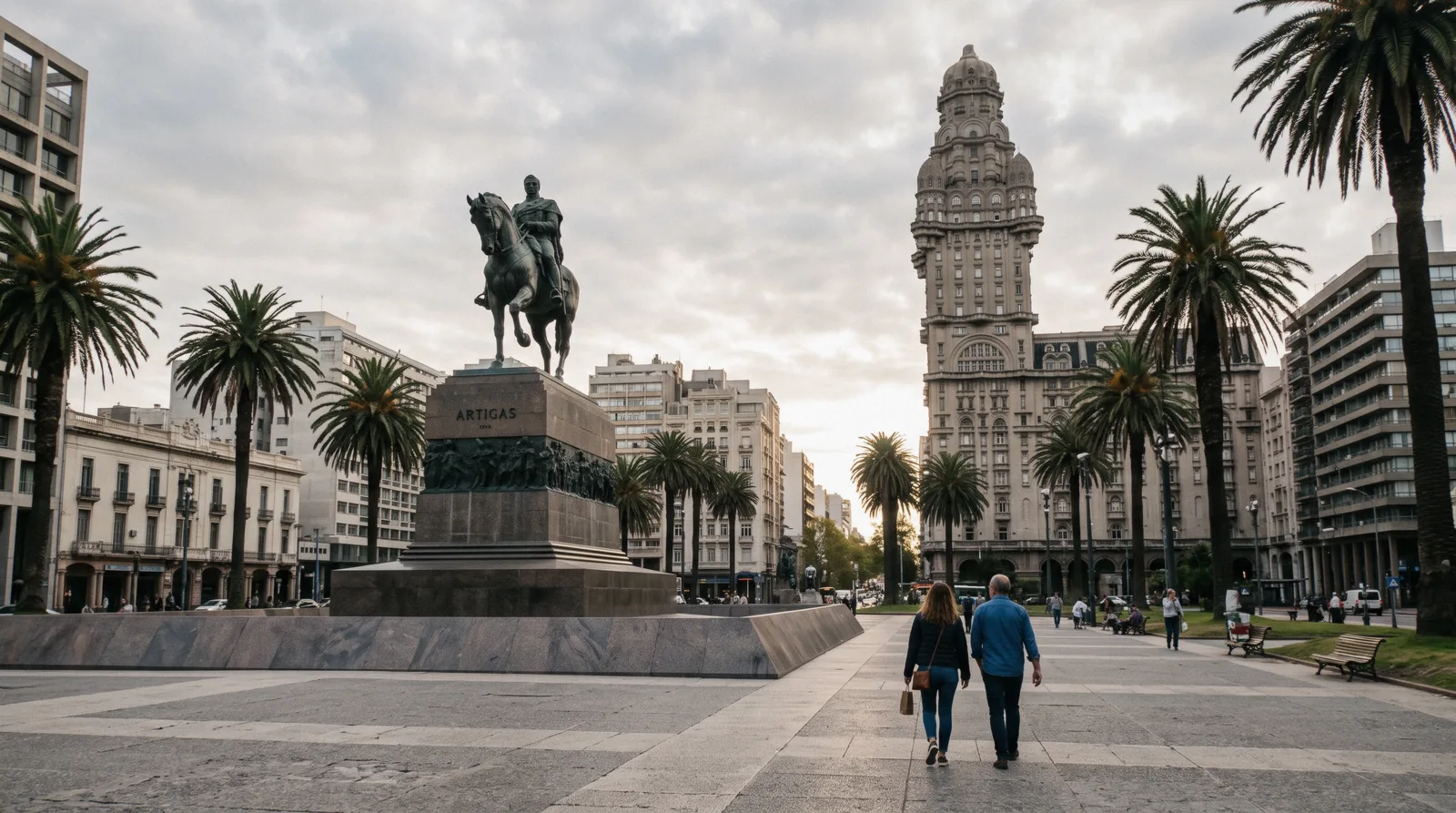
Plaza Independencia, Montevideo's main square, is the hinge between the old walled town and the modern centre. It sits where the Spanish Citadel once stood, and it is the official start of Avenida 18 de Julio. Around it ring three buildings you can enter: Palacio Salvo with its roof terrace, Teatro Solís with its guided visits, and the free mausoleum of José Gervasio Artigas under the central statue. This page covers each building and its visiting hours, the history of the square, how to get there, and where it fits in a day of things to see in Montevideo. Start here, then walk through the Citadel Gate into Ciudad Vieja.
Quick answer What it is, what to see, what is free
Plaza Independencia is a large square where Montevideo's old town meets its commercial centre. In the middle stands a 17-metre bronze equestrian statue of Artigas, inaugurated on 28 February 1923, and beneath it a granite mausoleum holding his remains, opened on 19 June 1977. The square and the mausoleum are free, with no set hours for the tomb. Palacio Salvo runs guided visits every day, including the roof terrace. Teatro Solís visits run Wednesday to Sunday and cost $9.92 (UYU 400) for foreign visitors.
Key takeaways
- Guided context comes with the Ciudad Vieja walking tour, which meets in front of the Citadel Gate and includes entry to the Artigas Mausoleum for $20 per person.
- The Palacio Salvo guided visit climbs to the roof terrace and includes the tango museum, and runs every day: the official Palacio Salvo ticket is $16, more on the Palacio Salvo page.
- A Teatro Solís visit costs $4.96 (UYU 200) instead of $9.92 (UYU 400) if you show the digital receipt for the Montevideo tourist tax your hotel charged you.
- When you finish on the square, walk west through Puerta de la Ciudadela onto the pedestrian street Sarandí and into the old town.
Key facts
Opening hours
| Square | Open–24 hours, every day |
|---|---|
| Palacio Salvo desk, Mon-Fri | 10:00–17:00 |
| Palacio Salvo desk, Sat | 10:00–14:00 |
| Palacio Salvo desk, Sun | 12:00–16:00 |
Closed Teatro Solís guided visits run Wednesday to Sunday only
Admission
- Adult
- Square and mausoleum free, [Palacio Salvo ticket](#tour-31) $16, Teatro Solís visit $9.92 (UYU 400) for foreigners
- Reduced
- Teatro Solís visit half price with the digital tourist-tax receipt
- Free
- The square, the Artigas monument, the mausoleum and the Citadel gate
Planning it
- Time needed
- Our estimate: half a day with the Salvo and Solís visits, 30 minutes for the square and the mausoleum
- Address
- Plaza Independencia, 11000 Montevideo, Uruguay
Six bookable ways to use Plaza Independencia, from the $20 walk that meets at the Citadel Gate and the $16 Palacio Salvo ticket to the city tours that stop here for photos. Prices are the operators' own listings in US dollars.
The square and the tomb are free. Do you want a guide to tell their story, or a bus that ties the square to the rest of the city?
| Option | Price | Length | What it does on the square | Book |
|---|---|---|---|---|
| Ciudad Vieja walking tourWalkers who want the tomb and the old town explained | $20 | 2.5 hours | Meets in front of the Citadel Gate, includes the Artigas Mausoleum | Check Availability |
| Palacio Salvo official ticket with guided tourAnyone who wants the view over the square from the tower | $16 | 1 hour | Entry and guide from the lobby on the square to the top-floor viewpoint | Check Availability |
| Private must-see sites walking tourSmall groups who want their own guide | $31 | 2-3 hours | Starts with the square and Palacio Salvo, private guide | Check Availability |
| Half-day tour with six stopsFirst-day visitors who want the whole city by coach | $20 | 3.5 hours | 15-minute photo stop and free time on the square | Check Availability |
| Half-day city tour with live guideVisitors who want a live guide on a city overview | $25 | 3.5 hours | The square with the Torre Ejecutiva and Teatro Solís | Check Availability |
| City tour for cruisersCruise passengers on a short call | $35 | 3 hours | Stops on the square on a port-to-port loop that waits for late ships | Check Availability |
Prices per person. Figures current {checked}.
Tours That Start or Stop on Plaza Independencia
Every card that uses the square, plus the hop-on hop-off bus with a stop here. More options on the Montevideo tours page.
 from $20
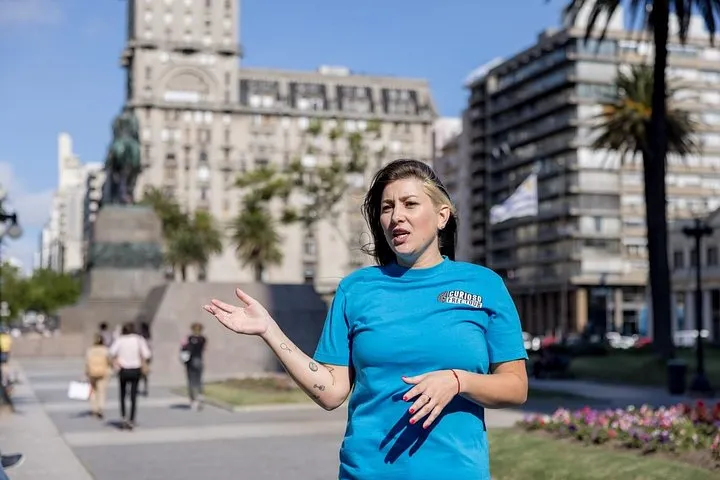
Historical and Cultural Tour of Montevideo Discover Old Town
A 2.5 hour guided walking tour of Montevideo's Old City with entry to three sights included for $20.
Check Availability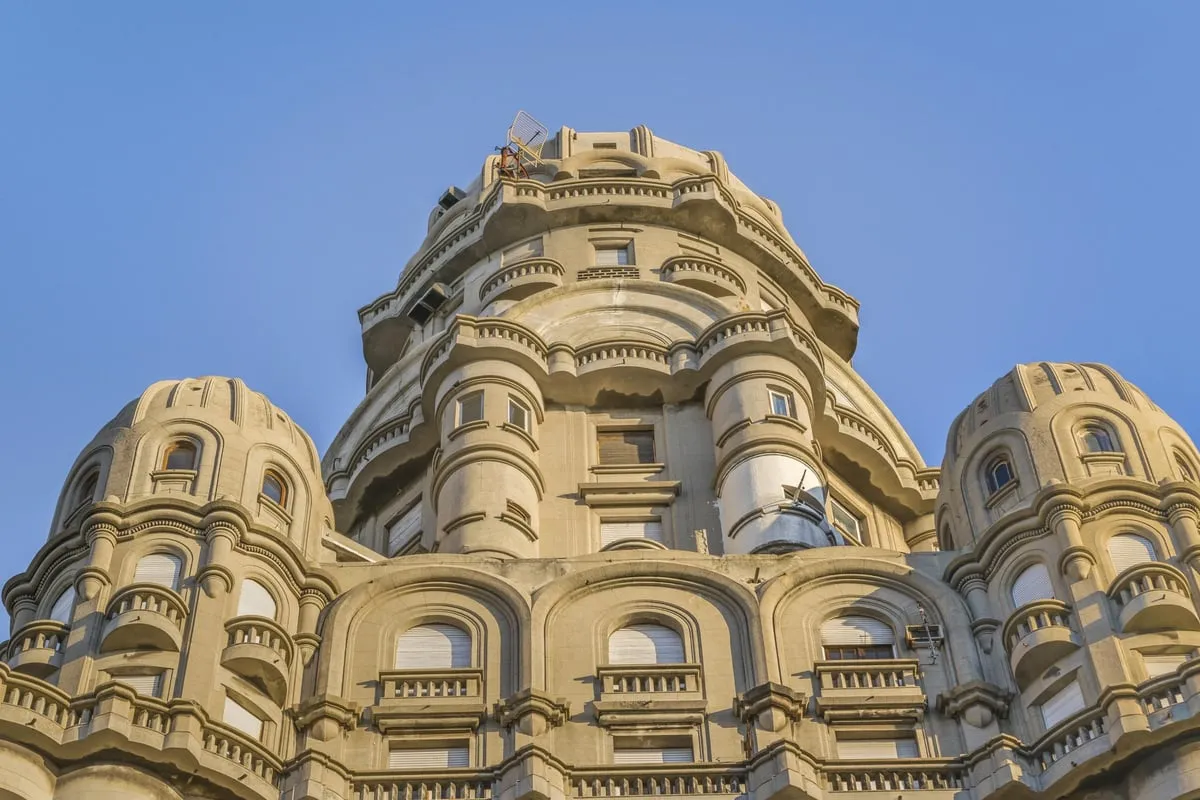 from $16
Montevideo: Palacio Salvo Official Ticket with Guided Tour
An official one-hour Spanish guided tour of Palacio Salvo ending at the top-floor viewpoint, from $16 per person.
Check Availability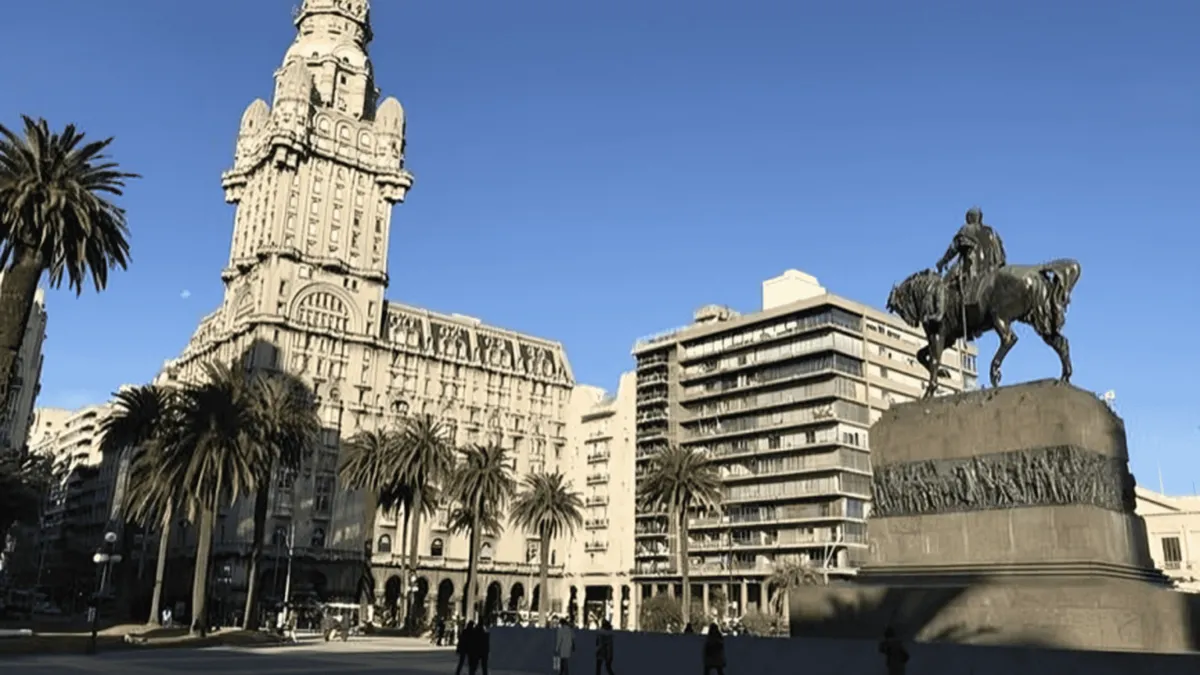 from $31
Montevideo: Must-See Sites Walking Tour With A Guide
A private customized walking tour with hotel transport, museum entry and a drink or food included, from $31 per person.
Check Availability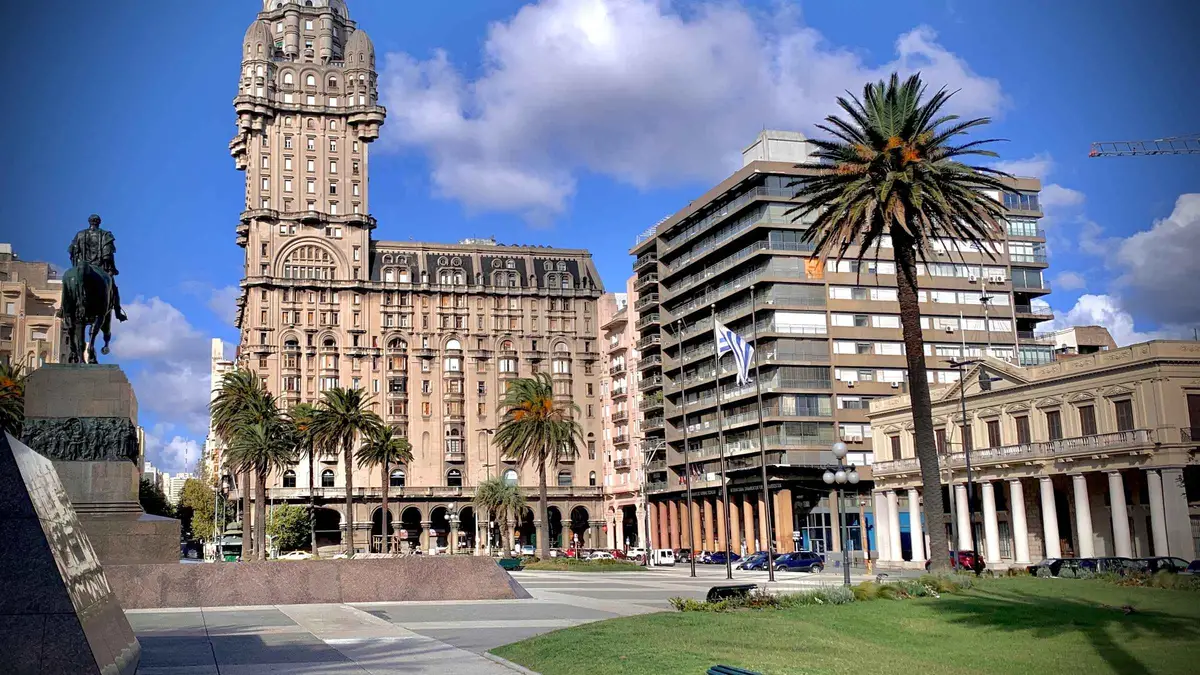 from $20
Montevideo: Complete Half-Day Tour with Guide and 6 Stops
Six-stop orientation coach tour of Montevideo at $20 per person with hotel pickup, free time at two markets and no entrance fees included.
Check Availability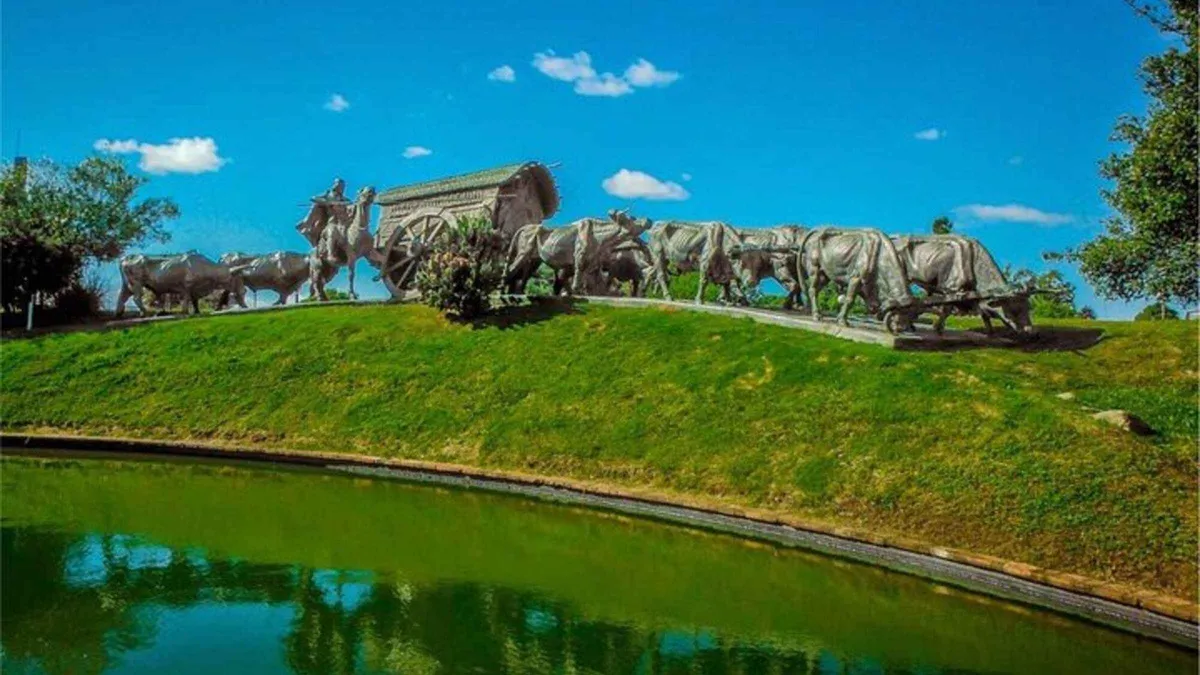 from $25
Montevideo: Half-Day City Tour with Live Guide
A short 3.5-hour overview of Montevideo's main sights with lunch included, from $25 per person.
Check Availability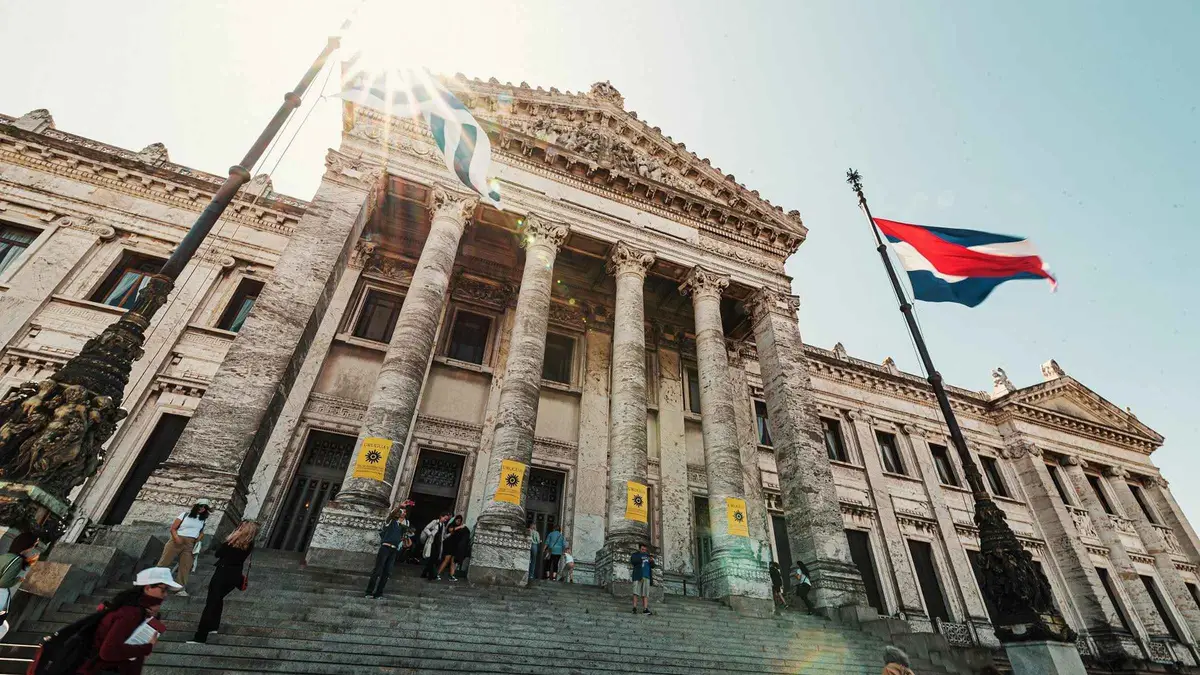 from $35
Montevideo City Tour for Cruisers
A 3-hour port-to-port overview tour at $35 per person that waits for late cruise ships and returns to the terminal.
Check Availability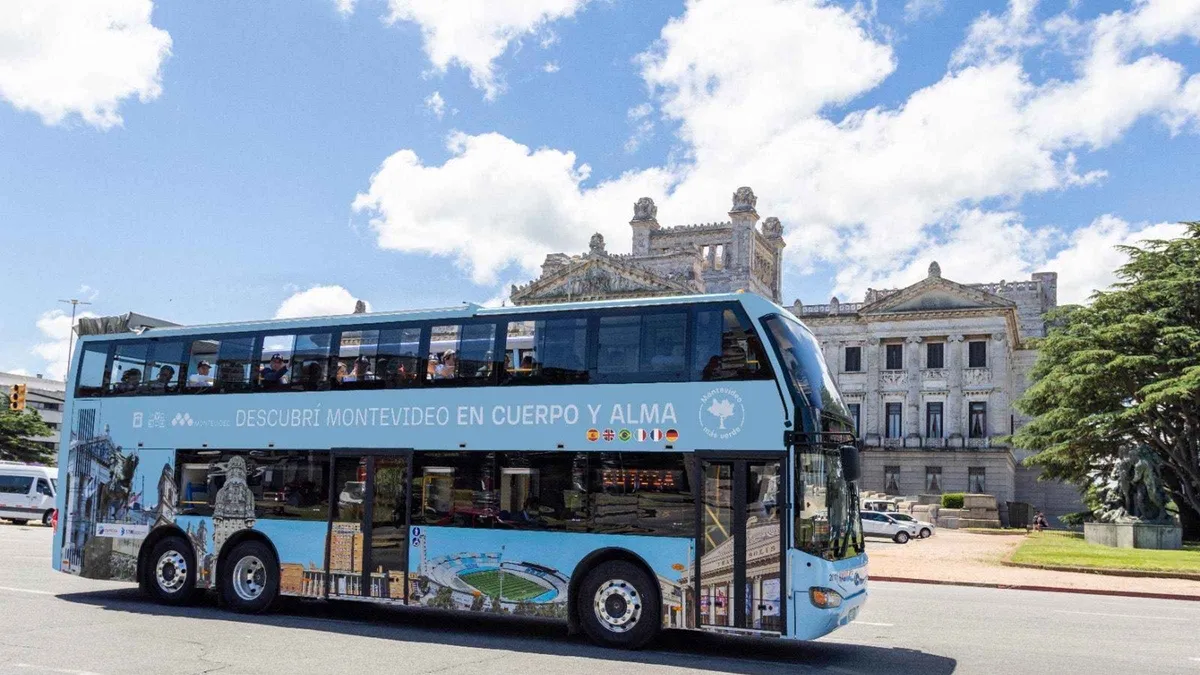 from $25
Montevideo: Sightseeing Hop-On Hop-Off Bus Tour
The cheapest city overview in Montevideo, a two-circuit 24-hour hop-on hop-off pass with audio guide for $25.
Check AvailabilityPrices, ratings and details are the platform's own. Dollar figures are the listed prices. The platform bills in your account's currency.
Around the Square, Building by Building
Walk the ring clockwise from the mausoleum in the middle. Our estimate is half a day for every door on the square you can enter.
What you can enter on the square, side by side. The schedules come from the city tourism office and the theatre's own visits page, and they decide the order of the walk.
| Building | Visit | Days | Price |
|---|---|---|---|
| Artigas mausoleum | Stairs down to the urn | No hours printed, go in daylight | Free |
| Palacio Salvo | Guided visit with roof terrace and tango museum | Every day, English slots daily | $16 with the official ticket |
| Teatro Solís | Guided visit of the theatre | Wednesday to Sunday | $9.92 (UYU 400) foreigners, half with the tourist-tax receipt |
| Puerta de la Ciudadela | Walk through it into Ciudad Vieja | Always open | Free |
| Palacio Estévez and Torre Ejecutiva | Seen from the square | No visiting hours printed | Free to view |
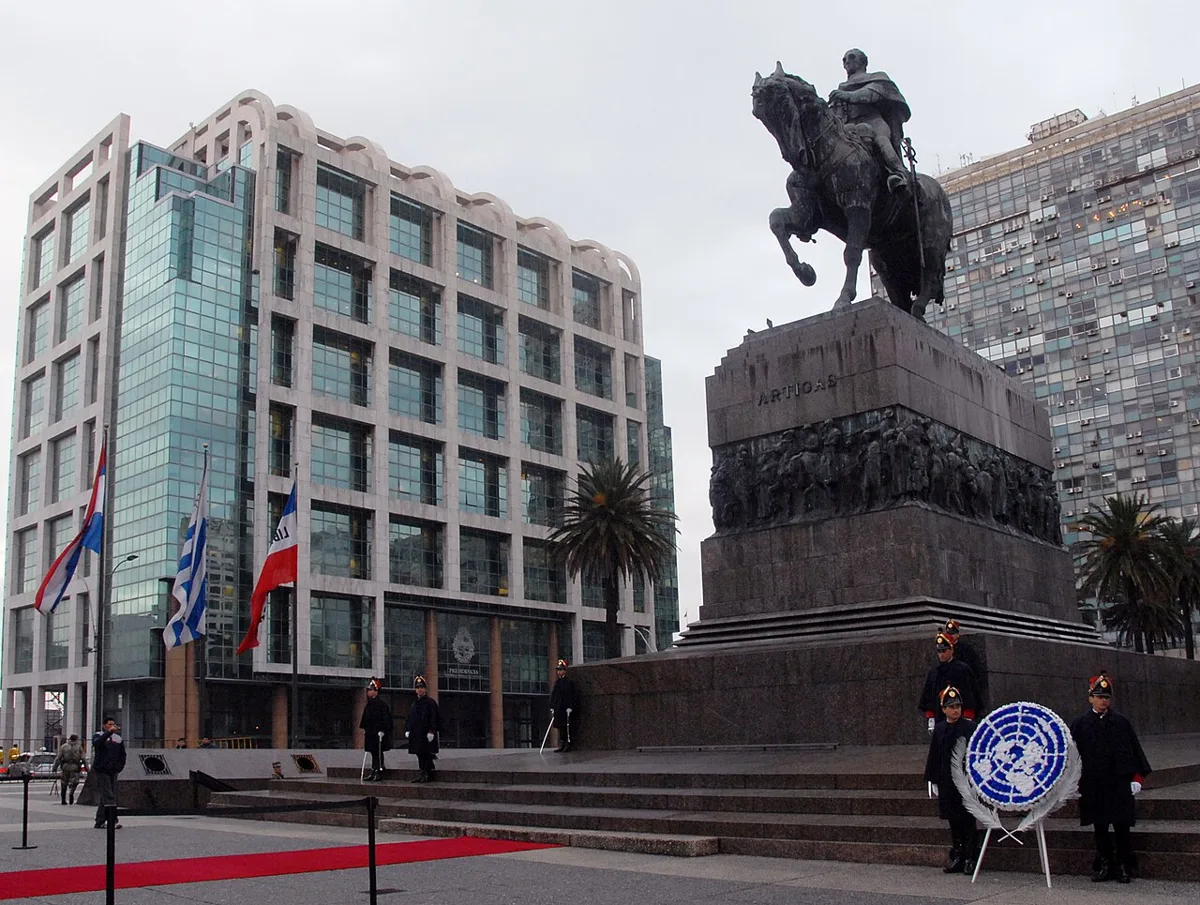
The Artigas monument, with the honour guard below and the Torre Ejecutiva behind. Photo: Andrés Franchi Ugart…, CC BY-SA 3.0, via Wikimedia Commons
The Artigas Monument
The centrepiece of Plaza Independencia is a 17-metre bronze equestrian statue of José Gervasio Artigas on a granite base, inaugurated on 28 February 1923. A competition in 1913 awarded the design to the Italian sculptor Angelo Zanelli. Artigas led the fight for Uruguay's independence and died in exile in Paraguay in 1850, and the city tourism office calls him the prócer, the founding hero.
There is no ticket and no gate: the monument stands in the open square, which is free, step-free and open at all hours. Stairs beside it lead down to his tomb, so the statue and the mausoleum are one visit.
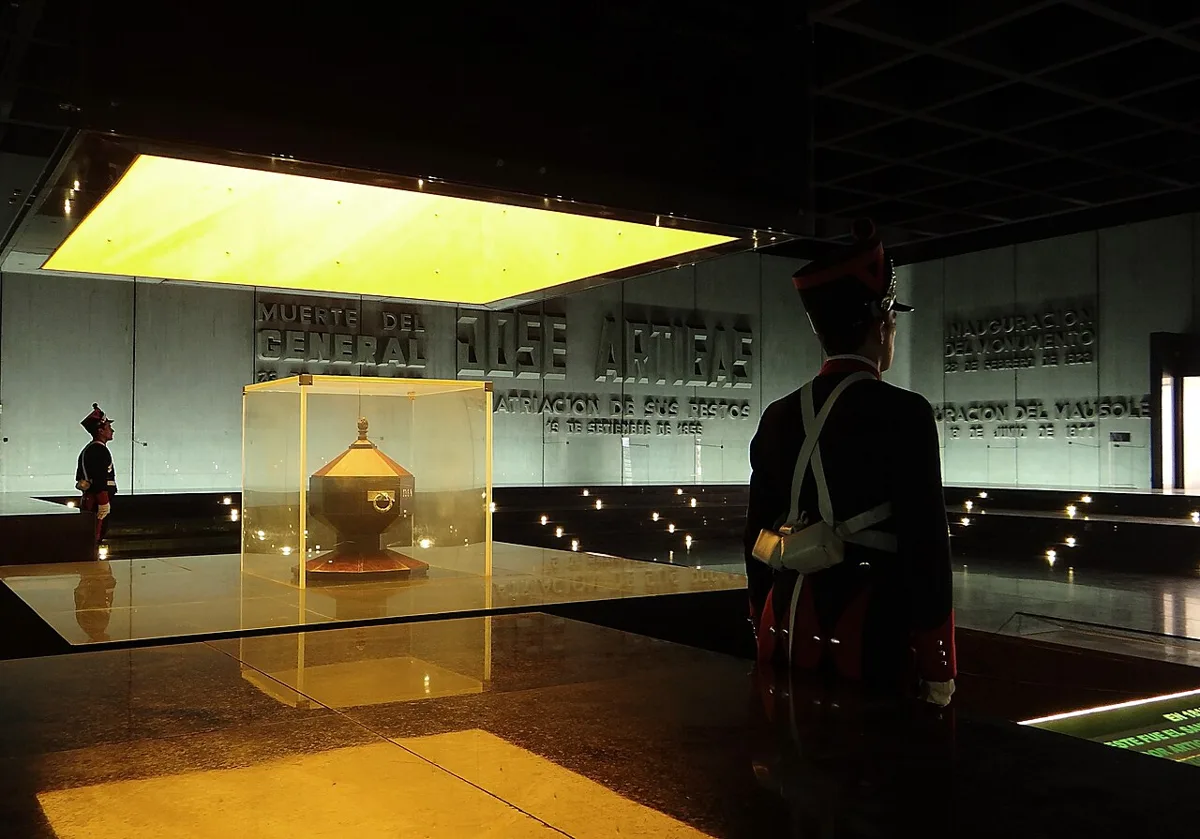
The urn in the mausoleum below the square, lit from above, with a Blandengues guard. Photo: Federico Cetrulo, CC BY-SA 3.0, via Wikimedia Commons
The Mausoleum Below
Beneath the statue lies the mausoleum of Artigas, approved on 27 September 1974 under the military dictatorship and designed by Lucas Ríos Demalde and Alejandro Morón. It was opened on 19 June 1977, the anniversary of Artigas' birth. Granite stairs lead down to the urn, and a granite mastaba above lets sunlight reach the urn.
A 2001 law ordered quotations by Artigas onto the walls. A honour guard of the Blandengues, a regiment with roots in Artigas' own military service, stands at the entrance. Entry is free.
No opening hours are printed, so go in daylight. The Ciudad Vieja walking tour includes entry to the mausoleum with a guide, which saves you guessing at the story on the walls.
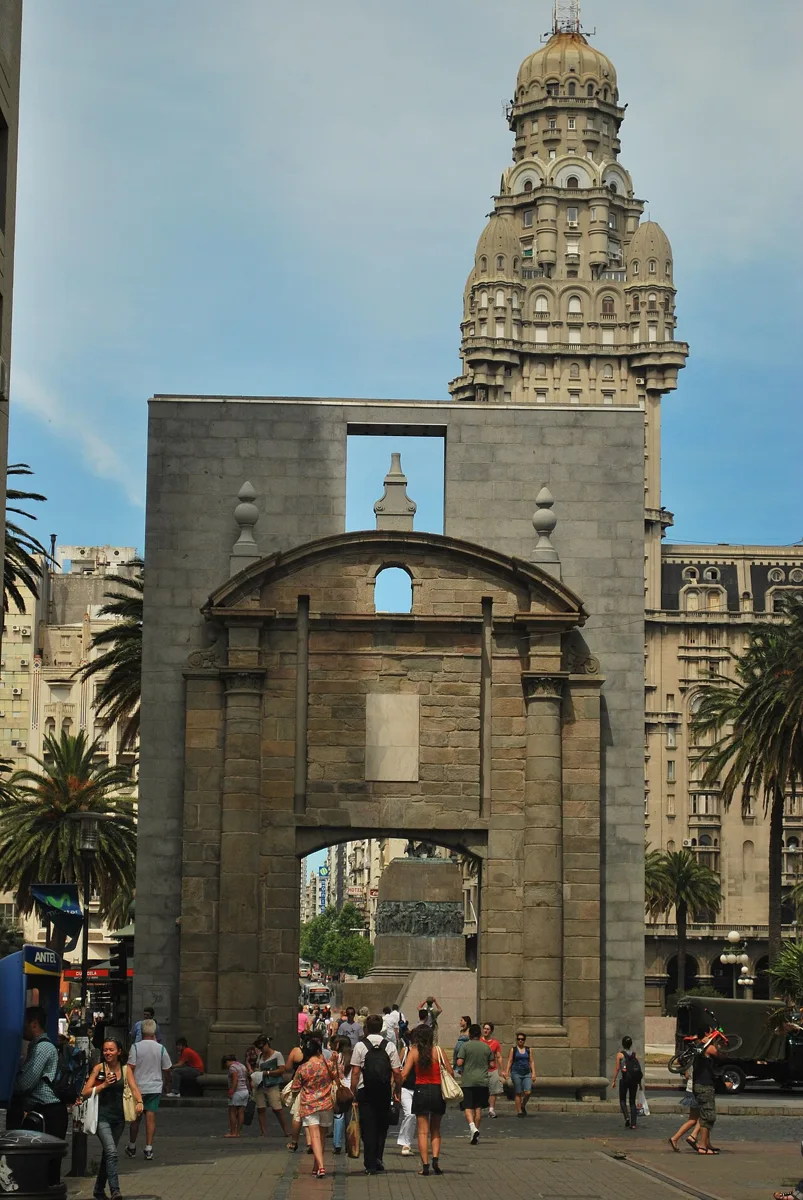
The Citadel gate from the old town side, with Palacio Salvo beyond the square. Photo: Ana Raquel S. Hernandes, CC BY-SA 2.0, via Wikimedia Commons
Puerta de la Ciudadela
The stone gate at the west end of the square is the last piece of the Citadel, the Spanish fortress begun in 1741 that occupied the ground the square now covers. When the walls came down, the gate was dismantled stone by stone and spent years as the rear gate of the Escuela de Artes y Oficios. It was rebuilt in 1959, a few metres from its original spot and aligned with the pedestrian street Sarandí, and restored again in 2009.
Today it works as a doorway between Plaza Independencia and the old town, and locals treat it as the start of the historic walk. You cannot enter it, you walk through it. Give it two minutes of attention, frame the arch with the Salvo tower beyond it, and then head into Ciudad Vieja down Sarandí.
Palacio Salvo
The tower on the east side, where the square meets Avenida 18 de Julio, is Palacio Salvo, opened in 1928 and for a time the tallest building in Latin America. The city tourism site gives its height as 95 metres, Wikipedia gives 101 metres to the roof and 105 with the beacon, so you will see both figures quoted. It was designed by Mario Palanti, who built a near-twin, Palacio Barolo, in Buenos Aires.
Guided visits run every day, and cover the outside of the building, the roof terrace and viewpoint, some notable floors and the Museo del Tango, because the cafe La Giralda stood here when La Cumparsita was first played. The official Palacio Salvo ticket costs $16 and pre-pays admission and the guide. English visits run at fixed slots on weekdays and weekends. Full schedule on our Palacio Salvo page.
Teatro Solís
On the south-west corner of the square stands Teatro Solís, the city's main theatre, officially opened on 25 August 1856 with a performance of Verdi's Ernani. Named after the navigator Juan Díaz de Solís, it took years to build, works having started in 1842 and stalled during the Siege of Montevideo. Guided visits run Wednesday to Friday at 16:00 and Saturday and Sunday at 15:00 and 16:00, and times can change, so confirm at the box office.
The visit costs $9.92 (UYU 400) for foreigners and $4.96 (UYU 200) with a national ID document. If you show the digital proof of payment of the Montevideo tourist tax, you get half off the foreign price. You pay at the box office by cash or card.
When no visit is running you can still walk in to the photo gallery and exhibition areas. Details on our Teatro Solís page.
Palacio Estévez and Torre Ejecutiva
The south side of the square holds two buildings of the executive branch. Palacio Estévez was the seat of the Uruguayan government in the 19th century and after, and next to it the Torre Ejecutiva is the president's office today. Since 2010, the public handover of the presidential sash at each change of government has taken place on Plaza Independencia in front of these buildings, which tells you how much symbolic ground this square holds.
No visiting hours are printed for either building, so plan to see them from the square. The changing of the honour guard happens at the mausoleum across the paving. The half-day city tour with a live guide covers the square together with the Executive Tower and the Solís Theatre in one pass.
Source: Descubrí Montevideo, Plaza Independencia, Descubrí Montevideo, Palacio Salvo, Teatro Solís, visitas guiadas, Wikipedia, Plaza Independencia.
From Citadel to Square
The square is young compared with the fortress it replaced, and its current look is a layering of two centuries of decisions.
The Citadel and the Walls
Montevideo began as a walled Spanish military town, San Felipe y Santiago de Montevideo, guarded by a Citadel whose construction started in 1741 on ground that is now the middle of Plaza Independencia. The walls enclosed a small peninsula above the port, and the Citadel sat at the landward gate, exactly where the square is today. After independence, the walls lost their purpose and were demolished, a process completed in 1877.
The stone gate was saved, taken apart piece by piece and reused as the rear gate of a trade school, and the rest of the fortification disappeared under the growing city. Only the Puerta de la Ciudadela survives as evidence of the walls, standing at the west edge of the square. So when you cross Plaza Independencia, you are crossing the exact line where the fortified town ended and open land began.
Zucchi, Thays and the Palms
With the fortress gone, the city laid out a new main square on the site. The Italian architect Carlo Zucchi drew up the plan from 1837, and the design is said to have been inspired by the Rue de Rivoli in Paris. In the early 20th century the landscaper Carlos Thays gave the square its greenery in the French style, with parterres, fountains and rows of palms.
The palms carry a story of their own, since they are said to stand for the Treinta y Tres Orientales, the leaders of the 1825 expedition that began Uruguay's fight for independence. The square was rebuilt again when the mausoleum opened in 1977, so today's granite paving dates from then.
The Statue and the Tomb
The monument to Artigas took a competition in 1913, won by the sculptor Angelo Zanelli, and an inauguration on 28 February 1923 to reach the square. Artigas himself had a long posthumous journey. He died in Paraguay in 1850, his remains were brought back to Uruguay in 1855 and placed in the National Pantheon of the Central Cemetery, where they lay for more than a century.
In 1974 the dictatorship approved the mausoleum under the statue, and it opened in 1977. After the return of democracy, the use of Artigas by the dictatorship was widely questioned, and the tomb stayed debated. The space was restored in 2011 and the remains returned on 26 October 2012.
Today an honour guard stands at the mausoleum, and visiting heads of state lay wreaths there.
Source: Wikipedia, Plaza Independencia, Wikipedia (es), Mausoleo de Artigas, Wikipedia (es), Puerta de la Ciudadela.
What Happens on the Square
Plaza Independencia is where the country stages its public ceremonies, which affects your visit on certain days.
Ceremonies, Marches and Closures
Since 2010, the public handover of the presidential sash at each change of government has happened on this square, in front of the Palacio Estévez and the Torre Ejecutiva. Foreign dignitaries on state visits lay wreaths at the mausoleum. The Marcha de la Diversidad, the annual pride march, starts here before filling Avenida 18 de Julio.
Expect barriers on those days, so keep a second slot for the tomb if it matters to you. Carnival runs about forty days from late January, and its opening parade uses Avenida 18 de Julio, which starts at the square: see our carnival in Uruguay page. No official events calendar for the square itself is printed, so ask at the tourist information office on Piedras 257, open every day 9:00-17:00, if you see barriers going up.
Getting to Plaza Independencia
The square sits at the end of the main avenue, so almost every route through the centre passes it.
On Foot, by Bus, from the Port and the Airport
The square is the western end of Avenida 18 de Julio and the eastern gate of Ciudad Vieja, so if you are anywhere in the centre or the old town you reach it on foot. City buses under the STM system charge $1.29 (UYU 52) for a one-hour ticket with the STM card, or $1.59 (UYU 64) in cash, cash costing more. From Carrasco airport, most airport buses stop at the Río Branco terminal near the square, according to a local guide, see our airport page.
Cruise passengers dock at the port beside Ciudad Vieja and can walk to the square through the old town, see our cruise port page. The hop-on hop-off bus has a stop on the square, and its 24-hour pass makes the ring of sights easy. The square is accessibility certified, with kerb cuts at every access and three ramps with handrails, so wheelchairs and strollers work. Travellers sleeping over can compare bases near the square and the old town on hotels in Montevideo.
Source: Intendencia de Montevideo, bus fares, Descubrí Montevideo, Plaza Independencia.
Plaza Independencia in Eight Dates
-
1741
The Citadel begins
The Spanish start building the Citadel on ground that is now the middle of the square, guarding the landward gate of the walled town.
-
1829
The walls come down
After independence the colonial walls are demolished, clearing the fortress ground for a new kind of public space.
-
1837
Zucchi draws the square
Carlo Zucchi lays out Plaza Independencia from 1837, on a design said to be inspired by the Rue de Rivoli in Paris.
-
1856
Teatro Solís opens
The city's main theatre opens its doors on the south-west corner of the square with a performance of Verdi's Ernani.
-
1923
The Artigas statue
The 17-metre bronze equestrian statue by Angelo Zanelli, winner of a 1913 competition, is inaugurated on 28 February 1923.
-
1928
Palacio Salvo rises
The tower on the north-east corner opens, at the time the tallest building in Latin America, 95 metres per the city tourism site.
-
1959
The gate returns
The Citadel gate, dismantled stone by stone when the walls fell, is rebuilt beside the square and aligned with the street Sarandí.
-
1977
The mausoleum opens
The tomb of Artigas beneath the statue, approved in 1974 under the dictatorship, is inaugurated on 19 June 1977, his birthday.
Dates below come from Wikipedia and descubrimontevideo.uy.
Do and Don't on Plaza Independencia
Do
- Go down into the mausoleum: it is free, and the Blandengues honour guard at the entrance is part of the visit.
- Pick a Palacio Salvo English slot early in the day, because the visits run at fixed times and include the roof terrace above the square.
- Keep your digital tourist-tax receipt from your hotel, it halves the foreign price of the Teatro Solís visit.
- Use the marked crossings and the three ramps with handrails, the square is accessibility certified and traffic circles it closely.
- Walk through the Citadel Gate onto Sarandí afterwards, the old town starts right there.
Don't
- Don't plan to go inside Palacio Estévez or the Torre Ejecutiva, no visiting hours are printed for either.
- Don't plan the mausoleum for late evening, no hours are printed for it and the entrance is best used in daylight.
- Don't assume the Solís visit times, they run Wednesday to Sunday and can change, so confirm at the box office.
- Don't walk alone downtown around the square at night or at weekends, the UK travel advice for Uruguay recommends against it.
- Don't skip the tango museum inside Palacio Salvo, it is part of the standard guided visit and covers the song first played on this spot.
Plaza Independencia on the Map
The square and every building on its ring, with the gate that leads into Ciudad Vieja.
Coordinates from Wikidata and OpenStreetMap.
Next Stops From Plaza Independencia
Three pages for the buildings on and beyond the square.
Palacio Salvo
The 1928 tower on the east side, with daily guided visits to the roof and the tango museum.
Teatro Solís
The 1856 theatre on the south-west corner, guided visits Wednesday to Sunday.
Plaza Independencia, Montevideo Questions
What is the history of Plaza Independencia in Montevideo?
The Spanish built a Citadel on this ground starting in 1741, and it guarded the landward gate of the walled town. The walls came down after independence and were fully demolished by 1877. Carlo Zucchi laid out the square from 1837, said to be inspired by the Rue de Rivoli in Paris. Carlos Thays landscaped it in the early 20th century, the Artigas statue arrived in 1923, Palacio Salvo in 1928, and the mausoleum under the statue opened in 1977.
What is Plaza Independencia in Uruguay?
It is Montevideo's main square, the point where the old walled town of Ciudad Vieja meets the modern centre of the city, and the official start of Avenida 18 de Julio. Around it stand Teatro Solís, Palacio Salvo, the Puerta de la Ciudadela, the Palacio Estévez and the Torre Ejecutiva. In the middle is the Artigas monument, with his mausoleum beneath it. The square is free to enter and open at all hours.
What is in Plaza Independencia?
The square holds a 17-metre bronze equestrian statue of Artigas from 1923, with his mausoleum below it, reached by granite stairs. On the corners and sides stand the Puerta de la Ciudadela gate, Palacio Salvo, Teatro Solís, the former seat of government Palacio Estévez and the president's Torre Ejecutiva. Gardens by Carlos Thays fill the middle, with palms said to stand for the Treinta y Tres Orientales.
Can you go inside the Artigas mausoleum?
Yes, entry is free. Granite stairs take you down to the urn, which sunlight reaches through an opening above. Quotations by Artigas, required by a 2001 law, cover the walls, and a honour guard of the Blandengues stands at the entrance. No opening hours are printed anywhere, so go in daylight and accept that guards or ceremonies can close it at short notice.
How do you get to Plaza Independencia?
Walk there from anywhere in the centre or Ciudad Vieja, since the square links both. City buses cost $1.29 (UYU 52) for a one-hour ticket with the STM card or $1.59 (UYU 64) in cash. Most airport buses stop at the Río Branco terminal near the square, according to a local guide. Cruise passengers reach it on foot from the port through the old town. The hop-on hop-off bus also stops here.
Is Plaza Independencia safe at night?
The square itself is a major public space with a permanent honour guard at the mausoleum, but the UK travel advice for Uruguay recommends avoiding walking alone downtown or in the port area at night and on weekends, and that covers this square. Use it in the evening only for a short, well-lit crossing, keep phones out of sight, and take a ride or a taxi rather than a long walk after dark.
How long should I spend on Plaza Independencia?
Our estimate is half a day: the statue and the mausoleum, the hour-long Palacio Salvo visit and the Teatro Solís visit, plus walking time. If you have only a few hours from a cruise ship, take the three-hour city tour for cruisers, which includes a photo stop on the square and waits for late ships, or simply do the mausoleum and the Salvo exterior before heading to the old town.
Where the Square Fits in a Day
The square is the hinge of a first day: the old town lies west, the centre east.
Start Here, Then West or East
Start your day on Plaza Independencia, because Palacio Salvo opens at 10:00 on weekdays and Saturdays. From there, two natural directions exist. Walk west through the Citadel Gate into Ciudad Vieja, down Sarandí past Plaza Matriz, and finish at lunchtime in the Mercado del Puerto, which is the classic first-day route.
Or head east along Avenida 18 de Julio toward the shops and the rest of the centre. If you would rather hand over the planning, our Montevideo tours page lists guided options that include the square, and our things to do in Montevideo guide helps you fill the rest of the day around it.
Plaza Independencia on Film
Three looks at the square, from the paving to the tomb below.
Así es la Plaza Independencia: el corazón de Montevideo
A walk around the square and its buildings, in Spanish.
Video: Caminando con MarceMontevideo, Mausoleo de Artigas y Plaza Independencia
The descent into the mausoleum and the urn.
Video: piscuajoWalking Tour on Avenida 18 de Julio and Plaza Independencia, Montevideo, Uruguay
The approach along 18 de Julio to the square.
Video: 4K WALKPrices, hours and terms are set by the venue or operator and confirmed at checkout.
We may earn a commission if you book through one of our links, at no extra cost to you. Full affiliate disclosure